

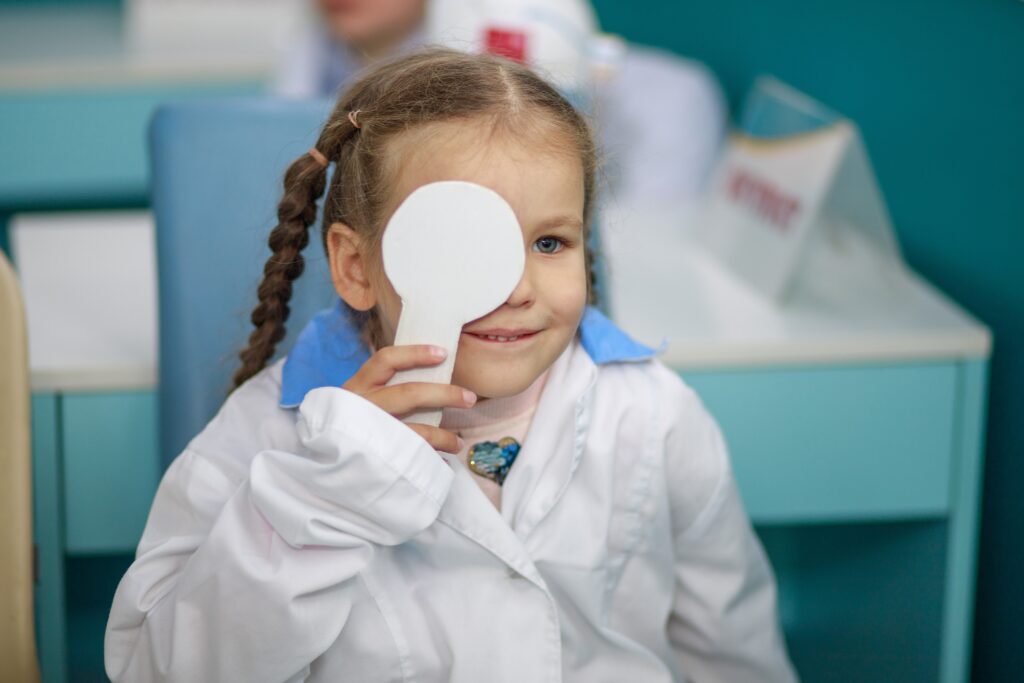
You’ve probably heard the term “lazy eye” countless times, but you may not be as familiar with the term amblyopia. Amblyopia is the medical term that refers to a reduction in vision due to improper development of the visual system. It is recognized as the most common cause of vision reduction in people under 45 years old. There are several causes of amblyopia, including but not limited to refractive error (glasses prescription), strabismus (eye turn), congenital cataracts, corneal scarring, and congenital ptosis (drooping lids). Amblyopia generally occurs in one eye, though occasionally may be diagnosed in both eyes if risk factors are present bilaterally. There are varying degrees of severity of amblyopia, with some patients demonstrating only mild reduction in visual acuity and others demonstrating severe reduction in visual acuity.
Amblyopia is diagnosed and treated in childhood, with the best treatment outcomes occurring when treatment is initiated prior to age 12. Therefore, it is important to have your child examined by an optometrist or ophthalmologist by age 12 to rule out risk factors for amblyopia.
There are a few signs that patients with amblyopia may exhibit. An eye with amblyopia will have significant blur, therefore a person may squint, show a strong preference for one eye, or frequently rub the weaker eye. Infants and toddlers may become fussy when their “good eye” is covered, as the “weak eye” will not allow them to see the world as clearly. People with amblyopia frequently have difficulty with spatial judgement and depth perception. There may be abnormal eye movements, such as an eye turning in or out or restricted movement of one of the eyes in a particular gaze position. Not sure if your child is exhibiting signs of amblyopia? It is best to have an eye exam to measure visual acuity and assess proper visual development.
People often use the term “lazy eye” to refer to an eye turn. While a patient with an eye turn (aka strabismus) may have amblyopia, this is not always the case. An eye turn must be constant and only occur with one eye for it to cause amblyopia. If you see your child’s eye turning occasionally, or if you see an alternation between which eye turns in or out, then amblyopia is not as likely to develop. However, your child may still have difficulty with depth perception, so it is important to see an eye care provider to assess the strabismus and determine if treatment is indicated.
Treatments of amblyopia vary depending on the cause of amblyopia. For patients with refractive and strabismic amblyopia, full time glasses wear is key to promote healthy visual development. Patching of the healthy eye for a few hours each day may also be recommended to strength development of the weaker eye. Vision therapy with a specialist may encourage visual development in all cases of amblyopia and may improve ocular alignment for patients with strabismus. Surgery may be an option for patients with strabismus if improvements cannot be made with glasses, patching, and vision therapy. For patients who have factors limiting the ability for light to enter the eye, such as cataracts, scarring, or ptosis, surgery may be required to allow for the eye to receive light properly. Ultimately, a visit to your eye doctor will help determine the best course of treatment.